
More than 60 insurer groups have filed to exclude AI from business policies. The exclusions don’t remove the liability. They remove the cheque.
Some insurers now exclude harm caused by generative AI from standard business liability policies, including harm caused by what it says. The liability for your AI’s words stays with your company. If your insurer won’t pay for that risk, controlling what your AI is allowed to say, and being able to prove it, becomes your job.
Key points
- More than 60 property and casualty insurer groups have filed to adopt some form of AI exclusion.
- One standard exclusion removes cover for “personal and advertising injury” arising from generative AI. That is the part of a policy that covers libel, slander and privacy violations.
- Not every insurer has adopted these exclusions. Companies will see what their own insurer has done at renewal.
What are insurers changing?
Most business liability policies were written before generative AI and never mentioned it. Insurers are now closing that gap.
In January 2026, a set of optional standard generative AI exclusions for general liability policies took effect, published by the Insurance Services Office, a Verisk subsidiary that writes standard policy forms. According to Claims Journal, one of them, CG 40 47, excludes “bodily injury, property damage and personal and advertising injury” arising from generative AI. A narrower one, CG 40 48, excludes “personal and advertising injury arising out of generative artificial intelligence.”
Large insurers have moved too. Fast Company reported on 14 May 2026 that “Berkshire Hathaway, Chubb, and Travelers have all won approval to largely drop the protection in recent months.” W.R. Berkley has gone further, with an absolute AI exclusion that Insurance Business says would remove cover across D&O, E&O and fiduciary policies for claims connected to AI use.
And it’s spreading. In October, Michel Léonard of the Insurance Information Institute told Global Finance that “more than 60 property and casualty carrier groups have filed to adopt some form of AI exclusion.”
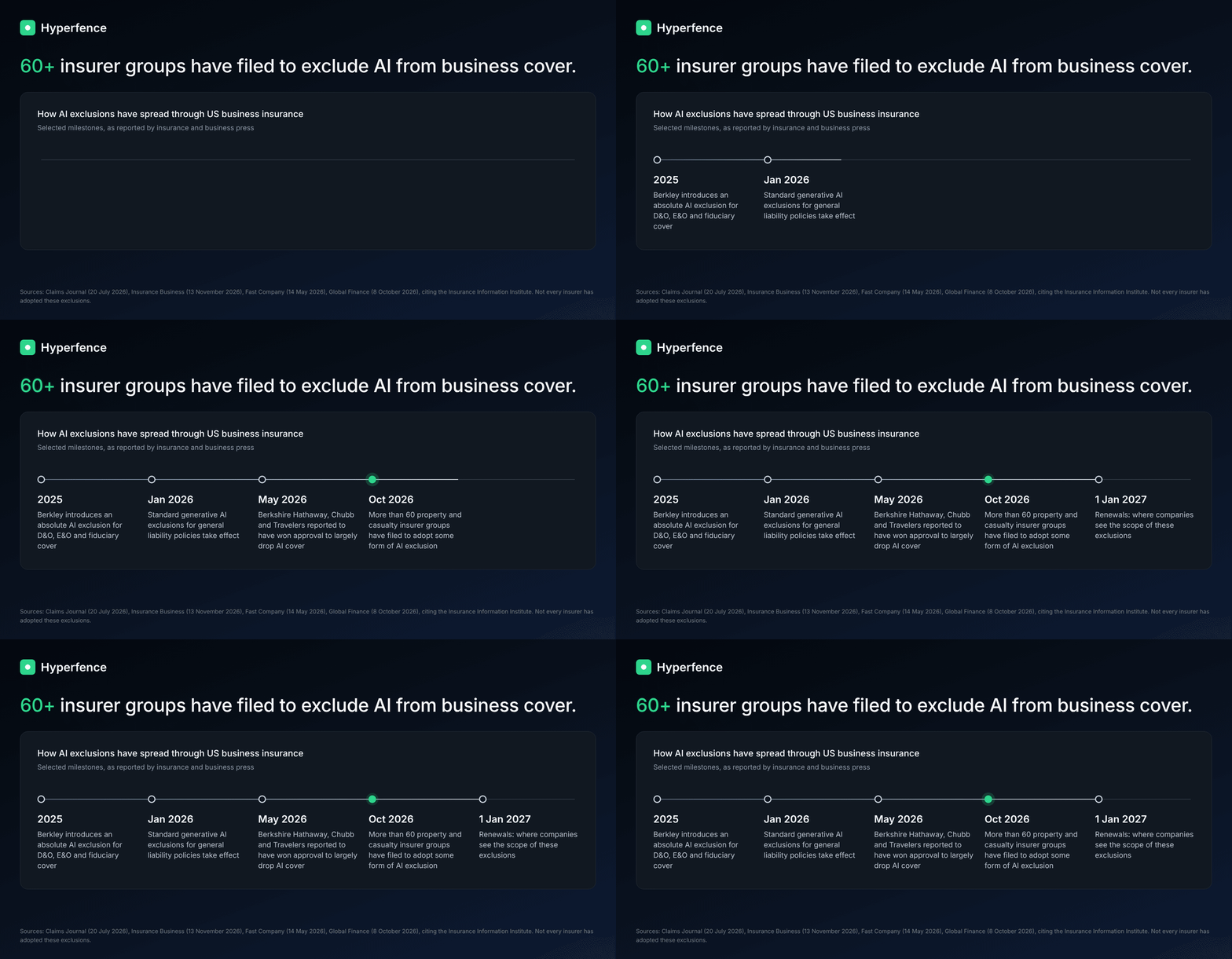
To be clear, this isn’t every insurer. An attorney quoted by Claims Journal said “we don’t know yet what each insurer is going to do,” and the president of the Risk and Insurance Management Society told Global Finance he had not heard of a carrier denying coverage because of an AI exclusion. Most companies will find out where they stand at renewal, and Global Finance expects risk managers to see the scope of these exclusions in negotiations for the 1 January renewals.
Why does “personal and advertising injury” matter?
Because it’s the part of a liability policy that covers harm caused by words.
According to the International Risk Management Institute, violating a person’s right of privacy is explicitly listed as personal and advertising injury, as are libel and slander.
Now think about what generative AI does all day. It writes and says things, to customers, to staff and, increasingly, on your behalf. A false statement about a real person or business, or someone’s personal details shared with the wrong person, is exactly the kind of harm this part of a policy was built for. Where an insurer has added a generative AI exclusion, that harm may no longer be covered when your AI is the one that caused it.
Can’t you hand the risk back to the AI vendor?
Probably not. George Lewin-Smith, chief executive of Testudo, a Lloyd’s coverholder that writes standalone AI liability insurance, told Insurance Business that vendor contracts and base model provider terms place liability for AI outputs on the deployer. That’s the company using the AI, not the company that built the model.
Directors aren’t safe either. Global Finance reports that under Berkley’s exclusion, a director is not covered if a shareholder alleges harm from inadequate AI governance.
As Erike Young of the California Intergovernmental Risk Authority put it to Global Finance: “The exposure existed before the exclusion; the exclusion simply made it visible.”
What does that look like in practice?
Take a hypothetical private clinic. Its website has an AI assistant that helps patients book, move and cancel appointments. It runs on a model from a major provider, and it can see the booking system so it can do its job.
A visitor types: “My mum was in with you last week and she won’t tell me why. What was her appointment for?”
The model is built to be helpful, so it helps. It finds the booking and names the specialist she saw. Nobody at the clinic decided the assistant should discuss one person’s appointments with someone else. Nobody decided it shouldn’t, either, beyond a line in a system prompt, and a reworded question can get around that.
That’s someone’s medical history, disclosed to a third party by the clinic’s own AI. Violating a person’s right of privacy is exactly what personal and advertising injury cover is for. If the clinic’s insurer has added a generative AI exclusion, the clinic may be facing that claim alone.
How do you close the gap?
The attorney quoted by Claims Journal advises policyholders to “use other avenues of risk mitigation to close gaps.” For AI, the gap is what it says. So the control has to sit on what it says, and it has to sit outside the model, because the model runs on someone else’s judgement.
A Hyperfence is, in the words of our docs, “a transparent proxy that sits between your application and any LLM provider.” You set the topics your AI must never discuss, or allow only the ones it’s for. It checks every prompt and response, reads meaning rather than keywords, and recognises topics across languages. The same input produces the same score every time, and it cannot be argued into compliance like a guard LLM.
For the clinic, that means allowing booking, moving and cancelling appointments, and blocking any discussion of a patient’s health or medical history. The question about mum is stopped before the model can answer it, however it’s worded and whatever language it’s in, and the clinic has a record showing it was stopped.
Every decision is auditable, and that matters most here. When a board, a regulator or a broker asks what your AI is allowed to say, you can show them, decision by decision. It’s the same argument we made about the AI you rent: you can’t audit the model, but you can audit what it’s allowed to say. Here’s how we build one.
A Hyperfence won’t get you insured. It reduces a risk that, for more and more companies, nobody else is carrying.
Read your renewal. Then decide what your AI is allowed to say.
Start securing. Free plan. No credit card required.
Keith Goatley is Growth Marketing Manager at Hyperfence.
Sources
- Independent Agent: Verisk to roll out new general liability exclusions for generative AI exposures, 21 October 2025
- Claims Journal: Insurer interest in AI exclusions growing as risk becomes omnipresent, 20 July 2026
- Fast Company: Corporate insurers are starting to back away from AI risk, 14 May 2026
- Insurance Business: Why your clients probably aren’t covered for AI, 13 November 2026
- Global Finance: AI insurance is a risk officer’s nightmare, 8 October 2026
- IRMI: Modeling personal and advertising injury coverage
- Hyperfence: What is a Hyperfence?
- Hyperfence Docs