
Every security flaw published in 2026 that mentions prompt injection, and what the attacks actually reached.
Key points
- Between 1 January and 30 October 2026, 108 security flaws published in the CVE List mentioned prompt injection. In 90 of them, or 83%, the harm came through access the AI had been given: running code, reaching files or internal systems, or acting through connected tools.
- 23 of the 108 described an approval step that was missing, could be bypassed, or was left to the model itself to decide.
Part 1 of this series covered what prompt injection is, and part 2 looked at why it can’t be fixed inside the model. If some attacks will always get through, the more useful question is what determines how much damage they do.
What the flaws actually did
The CVE List is the public register of security flaws found in real software. We took every entry published between 1 January and 30 October 2026 whose description mentions prompt injection, 108 in total, and sorted each one by what the injected instructions ended up doing.
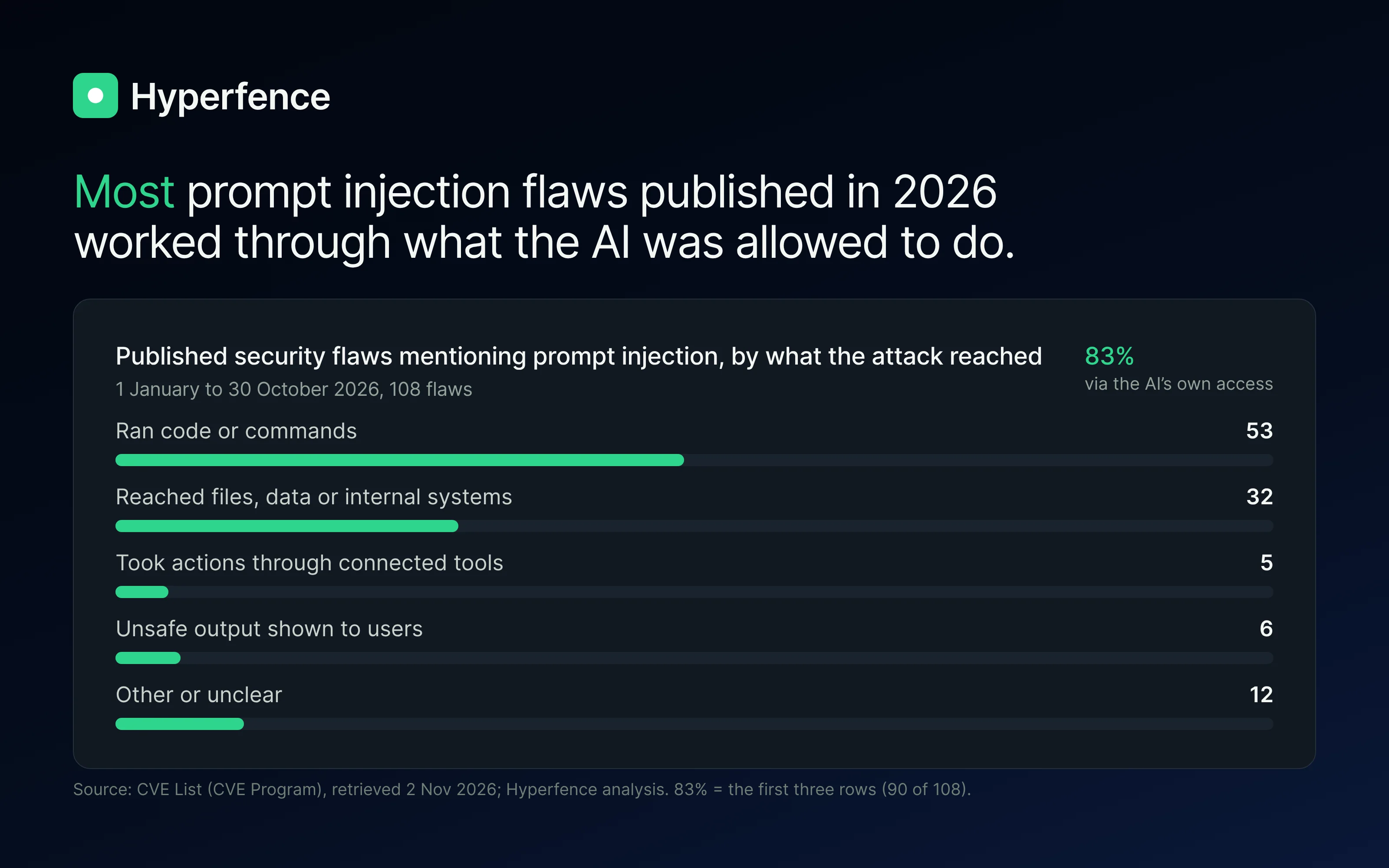
In 53 of the 108 cases, the injected text led the AI to run code or commands. In another 32, it read, wrote or sent out files and data, or reached systems inside the network. In five more, it acted through a connected service, for example by sending messages or making API calls.
That is 90 of the 108, or 83%. In each, prompt injection was a way in, but the damage came from access someone had already given the AI.
Where the safety checks failed
Safety checks were a recurring weak point. According to the descriptions, 23 of the 108 flaws involved an approval step that was missing, could be bypassed, or was left to the model to decide.
Five of those were published against a single coding assistant, Roo Code, on the same day, each describing a different way to get a blocked command past its approval check. In four other AI tools, the model itself decided which commands were safe enough to run without asking the user, which meant an attacker who could steer the model could also steer that decision.
It is the same problem part 2 described: a check that depends on the model’s judgement can be influenced by whoever is influencing the model.
Six ways to limit the damage
None of these steps stop prompt injection, but each one reduces how much a successful attack can reach.
- Give the AI less to reach. Limit it to the files, tools and data its job needs, since every extra permission is something an attacker can use.
- Keep approvals outside the model. Anything that can’t be undone, such as running a command, sending a message or moving money, should depend on a decision the model can’t make or influence.
- Treat what the AI writes as untrusted. Six of the flaws came from AI output being shown to users without being cleaned first, and others leaked data through image links that the app loaded automatically.
- Block outbound requests by default. A recurring pattern this year was AI tools fetching any web address they were given, including addresses inside the company’s own network.
- Assume the content it reads may be hostile. Emails, web pages, documents and even file names all appear in this year’s flaws as ways in.
- Keep it on its intended job. One flaw this year involved a chatbot that could be led into returning “prohibited information and information outside its intended context.” An assistant limited to the topics it was built for has less to give away, which is the kind of rule a Hyperfence enforces from outside the model.
What the record shows
Across the three parts of this series, the evidence points the same way. Prompt injection is easy to attempt and, on current research, not possible to stop completely, so the controls that matter most decide what a successful attack can reach.
Most of this year’s flaws were not about clever wording. They involved AI systems that could run code, reach files or contact other systems, and in many cases checks that could be bypassed.
See a check that sits outside the model. Fight Club is a live Hyperfence. Try to talk it round: hyperfence.io/demo
How we counted: we searched the English descriptions of all published CVE List records with IDs from 2023 to 2026 for “prompt injection”, kept those published in 2026 up to 30 October, and classified each one by the end result its description gives. Where a description named more than one result, we used the most severe. The full list is available on request.
Sources
- CVE Program: CVE List (cvelistV5), records published 1 January to 30 October 2026, retrieved 2 November 2026
- CVE-2026-4399: prompt injection in the 1millionbot Millie chatbot
- Hyperfence: What prompt injection actually is, part 1 of this series
- Hyperfence: Why prompt injection can’t be fixed inside the model, part 2 of this series
- Hyperfence: What is a Hyperfence?