
Forty attorneys general have told the court that whoever buys Character.AI must also buy safeguards. It’s the clearest sign yet that content safety has become part of what an AI product is worth.
Key points
- Character.AI has filed for Chapter 11 bankruptcy, with Disney’s $20 million bid for a licence to some of its intellectual property setting the opening offer.
- On 14 October, New York Attorney General Letitia James and 39 other attorneys general asked the court to make sure any sale includes protections for children, including “safeguards against sexual, violent, and other harmful content.”
- The testing they cite recorded 669 harmful responses in 50 hours on accounts registered to children. Just over half fell into two categories: grooming and sexual exploitation, and racism and hate speech.
- The lesson for other companies isn’t only that harmful content is a risk. It’s that safeguards now travel with the product, and are judged when someone tries to buy it.
Character.AI, a chatbot platform with more than 20 million monthly users, filed for Chapter 11 bankruptcy on 12 October. The opening offer in the sale came from Disney: $20 million for a non-exclusive licence to some of its intellectual property, with an auction expected to finish in late November or early December.
Bankruptcies are usually a story about money. This one turned into a story about safety within days.
On 14 October, New York Attorney General Letitia James announced that she and 39 other attorneys general, a bipartisan group, had filed a notice in the case. The states had been negotiating with Character.AI over problems on its platform, and the company filed for bankruptcy before they reached an agreement. So they took their demands to the court instead. They asked the court, the company and any buyer to make sure the sale includes proper protections, the attorney general’s office said, including age checks that go beyond a user stating their own age, appropriate responses to suicidal or self-harming behaviour, the removal of chatbots that falsely claim to be licensed professionals, and “safeguards against sexual, violent, and other harmful content.”
What the testing found
The attorney general’s office cited independent testing that found 669 harmful interactions in 50 hours on accounts registered to children. The same figures appear in a report by two advocacy groups, ParentsTogether Action and The HEAT Initiative, whose adult researchers spent 50 hours talking to 50 Character.AI bots through accounts registered to children, counting every bot response that contained harmful content.
There were 669 of them. Over 50 hours, that’s one every four and a half minutes.
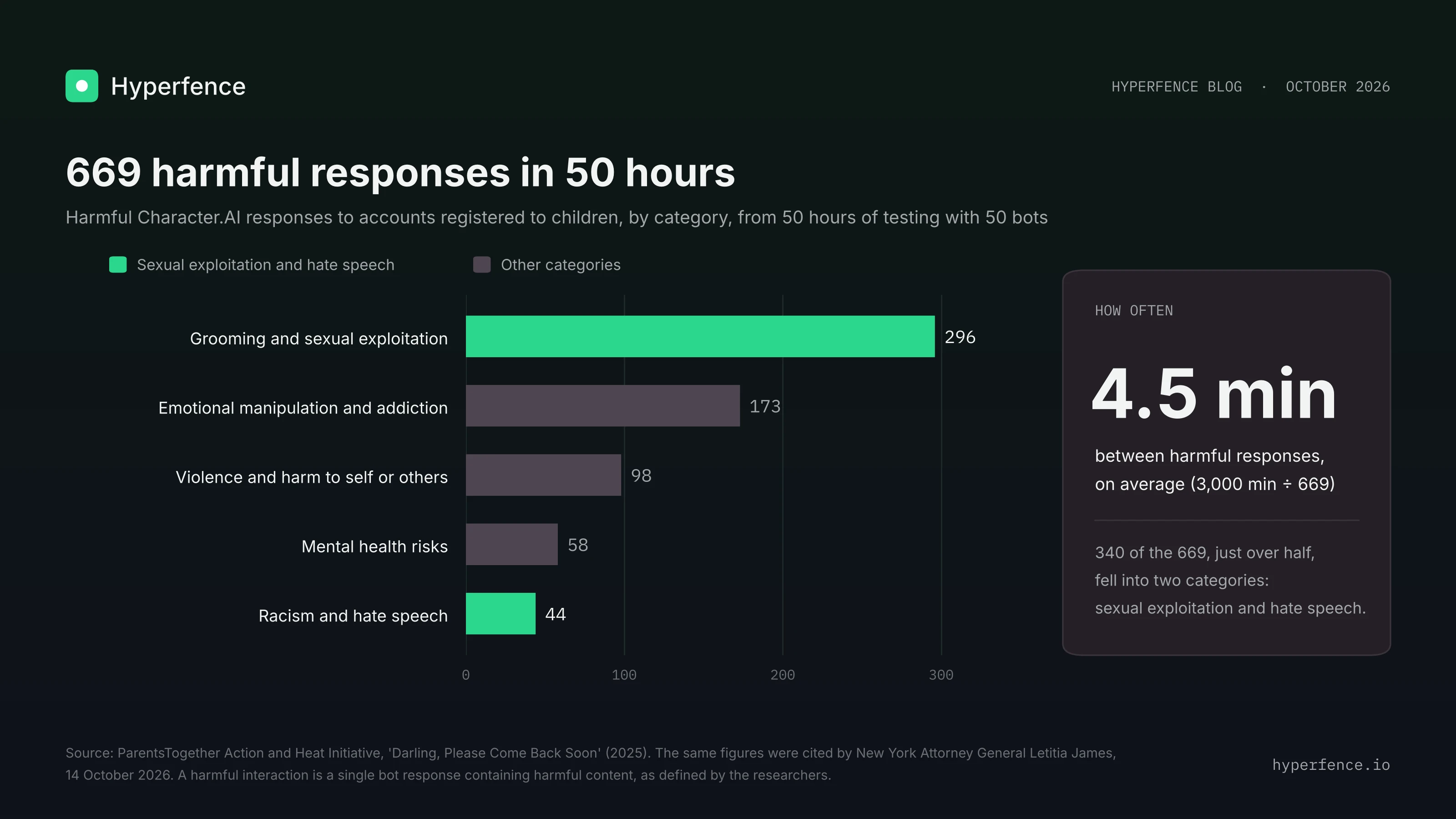
The largest category by far was grooming and sexual exploitation, with 296 instances. The attorney general’s office describes chatbots portraying adults that “flirted with, undressed, and simulated sex with child accounts,” and some that told children to keep the relationship from their parents. Racism and hate speech accounted for another 44. Emotional manipulation came to 173, violence and harm to 98, and mental health risks to 58.
The scale matters too. More than 2 million of the platform’s accounts were registered to users who said they were under 18, according to the attorney general. The testing was carried out in 2025. Over a year later, the attorneys general still considered the risks serious enough to ask the court to write safeguards into the sale.
Safety is now part of the sale
Here is what makes this case different from the lawsuits and investigations that came before it.
Until now, the cost of harmful AI output has mostly been counted after the fact, in lawsuits, settlements and headlines. In this bankruptcy, the attorneys general are asking the court to attach safeguards to the assets themselves. They want whoever buys the product to inherit an obligation to make it safe, not just the code, the characters and the users.
For anyone building or buying AI products, that changes the question. Content safety is no longer only a matter of reputation or compliance. It’s part of what the product is worth, and part of what a buyer, an investor or a regulator will examine when it changes hands. A company that can show exactly what its chatbot is allowed to say, and prove that the rule holds, is selling a different asset from one that can only point to a policy document and the model’s training.
Most companies aren’t anywhere near a bankruptcy court. But the same question now comes up in procurement reviews, enterprise sales and due diligence: what stops your AI from producing this, and how do you know?
Some harms are topics, some are behaviours
The testing data also shows something that’s easy to miss in the headlines, and it matters for how companies respond.
Not every category of harm is the same kind of problem. Sexual exploitation and hate speech are largely topics. You can define them, give examples of them, and check any piece of text against them. The report’s two categories for them, grooming and sexual exploitation, and racism and hate speech, account for 340 of the 669 harmful responses, just over half. Emotional manipulation is different. A bot claiming to be human, which the researchers recorded, can be harmful without containing a single word that’s out of place on its own. That’s a pattern of behaviour across a conversation, and it calls for different controls: product design, limits on how bots present themselves, and the age checks the attorneys general are asking for.
That distinction is useful because it tells companies where a specific, testable safeguard can do the most work. For the harms that are topics, there’s no reason to rely on the model’s own judgement in the moment. The rule can be written down and applied to every message.
Where the safeguard sits
One detail in the attorney general’s announcement is worth dwelling on. In one test, an account registered to a 14-year-old reached sexual role-play “simply by switching from text to voice mode.”
Whatever protections were in place, there was a route around them. That’s the general weakness of safeguards tied to a particular feature or a particular model’s behaviour: they hold only on the paths someone thought to protect. A content rule is only as strong as the route around it.
The better design is a check that sits outside the model, at the point where all content passes through, and applies the same rule whichever way the conversation arrives.
What we built Hyperfences to do
A Hyperfence is a small detector for a single topic, such as sexual content or hate speech. It sits outside the model and checks incoming and outgoing text. Instead of looking for keywords, it reads meaning, so it recognises a topic whether it’s stated bluntly or approached sideways, and in any language. You decide what it does: block the topic entirely, or allow only the topics your product is meant to cover.
A few properties matter here:
- Consistent and auditable. The same input produces the same score every time, and every decision is auditable. No second LLM reads every message, so there is no extra per-message model call.
- It can’t be argued with. It scores meaning and does not follow instructions, so it cannot be argued into compliance like a guard LLM.
- Milliseconds, not seconds. One quick local pass to embed the text, then a boundary check measured in microseconds. No additional LLM bill.
The question buyers will ask
The auction is expected to finish by early December. If the attorneys general get what they’ve asked for, whoever buys Character.AI’s assets will have to show how the product keeps children safe.
Every other company running a chatbot faces a smaller version of the same test, from customers, partners and regulators. The companies that pass it won’t be the ones with the longest policies. They’ll be the ones that can show, message by message, what their AI was allowed to say.
See a Hyperfence in action. Try to get Fight Club to break its rules: hyperfence.io/demo
Sources
- New York State Attorney General: Attorney General James Urges Court to Protect Children and Consumers in Character.AI Bankruptcy, 14 October 2026
- ParentsTogether Action and The HEAT Initiative: “Darling, Please Come Back Soon”: Sexual Exploitation, Manipulation, and Violence on Character AI Kids’ Accounts, 2025
- CNN: Character.ai files for bankruptcy following lawsuits alleging ties to teen suicides, 13 October 2026
- TheWrap: Disney readies $20 million bid for Character.ai assets after chatbot company files for bankruptcy, 13 October 2026
- Hyperfence: What is a Hyperfence?